

LADOTD Deck Evaluations
BDI is an industry leader in advanced methods for concrete deck evaluation, using technologies such as High-Resolution Imaging and BDI’s proprietary SounDAR system to perform deck evaluations with efficiency and accuracy. BDI was engaged by the Louisiana Department of Transportation and Development (LADOTD) to perform a nondestructive evaluation (NDE) of four structures carrying I-10 over the Reserve Relief Canal and Lake Pontchartrain. Together, these bridges represent approximately 18 miles of bridge span, presenting a major challenge for deck investigation which was overcome with the help of BDI’s vehicle-mounted investigation equipment. The goal of this project was to perform an advanced inspection to characterize the condition of the decks, including the extent and location of defects. BDI employed the following methods:
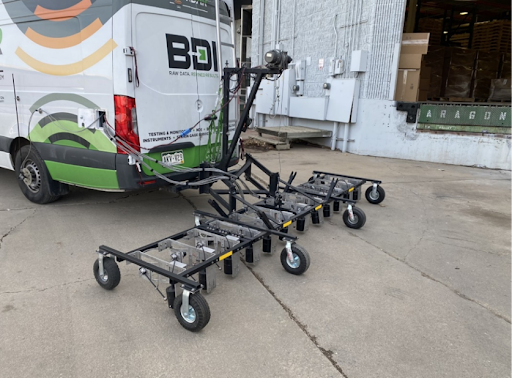
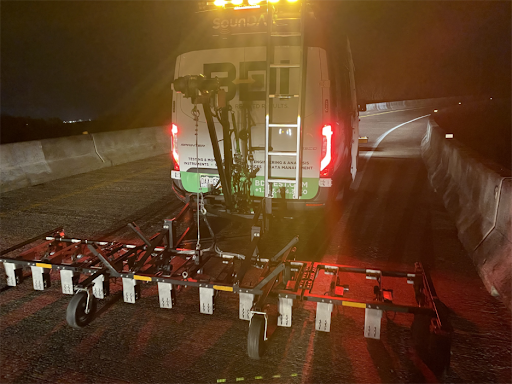
- SounDAR: BDI developed the SounDAR method as an advanced acoustic technique for assessing concrete integrity, particularly delaminations, by combining elements of traditional and modern nondestructive testing methods. It uses a system of 12 impactor/sensor pairs to induce and record dynamic responses via isolated microphones, which capture sound and vibration data. The assembly is designed to attach to a vehicle for efficient testing of large bridge decks, while GPS tracking is used to match data to the corresponding deck location. Response signals are transformed to the frequency domain using a Fast Fourier Transform (FFT) and analyzed spectrographically to identify degraded areas. Unlike manual chain drag sounding methods that rely on human perception, SounDAR employs an algorithm to objectively classify concrete conditions based on signal power thresholds, offering a more comprehensive and quantitative evaluation of structural health.
- Infrared Thermography (IR): This non-destructive electromagnetic technique is used to assess the thermal properties of materials by measuring the infrared energy they emit. In concrete evaluation, it relies on the principle that uniform, healthy concrete exposed to consistent sunlight will exhibit uniform temperatures. Defects like delaminations or debonding disrupt this uniformity, creating localized temperature anomalies due to differences in heat absorption and emissivity. In accordance with ASTM D 4788, high-resolution imaging (HRI) data was paired with IR to differentiate delaminated areas from surface features (discoloration, oil stains, sand and rust deposits, etc.) that appear in the infrared imaging.
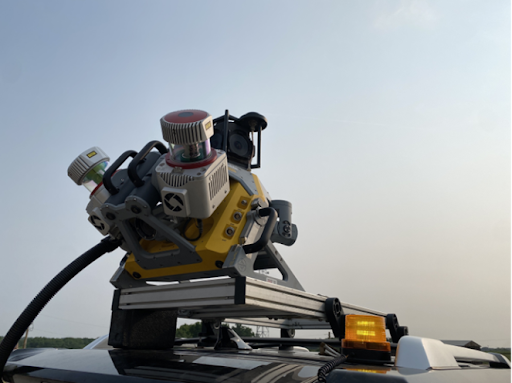
- High Resolution Imaging (HRI) and Crack Mapping: HRI enhances visual bridge inspections by capturing detailed images of the entire bridge deck quickly and efficiently. Instead of relying on isolated photos, BDI uses advanced imaging and photogrammetry software to stitch together high-resolution images into a single, continuous visual record of the deck’s surface. This method allows for comprehensive documentation without disrupting traffic or requiring lane closures. For HRI data collection, BDI employs unmanned aerial vehicles (UAVs) and/or camera-equipped roadway vehicles, though only the latter was used in this investigation. Using HRI, BDI generated a map of deck cracking.
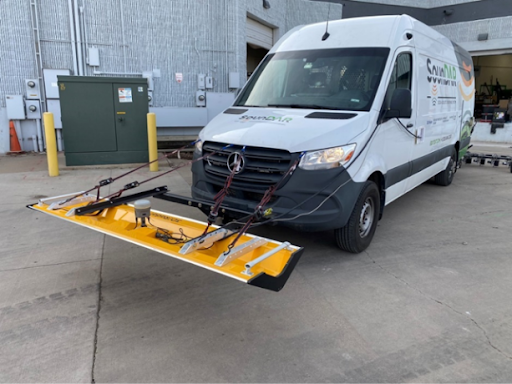
- High-Speed Ground Penetrating Radar (GPR): This non-destructive testing method uses electromagnetic waves to detect subsurface features in concrete. An antenna transmits energy into the material, and reflections occur at points where there are changes in dielectric properties (e.g., air/concrete, concrete/steel). These reflections are analyzed to determine the location and depth of features such as steel reinforcement, voids, and moisture. High-speed GPR uses vehicle-mounted GPR equipment to scan bridge decks with greater efficiency and without need for bridge closures.
- Coring and Material Testing: Concrete cores are subject to a multitude of tests including chloride testing, compression testing, petrographic testing, and more. While BDI can extract cores for all testes need, chloride testing was selected for this project. Chloride testing is performed to assess the concentration of chloride ions within concrete, which are a major contributor to corrosion of embedded steel reinforcement. BDI conducted chloride testing on concrete cores from selected deck locations. Handheld GPR was used to avoid reinforcing locations when drilling cores, and coring locations were patched with a DOTD-approved concrete. Chloride testing was then performed on the samples in accordance with AASHTO T260-21.
BDI’s trained engineers processed the data from all decks to provide both a comprehensive summary of the deck’s condition state and detailed information on the location and extent of defects. Comprehensive results, including all defect types investigated as well as reinforcement cover depths, were provided to LADOTD with a detailed breakdown by structure and span, providing LADOTD with critical information which can assist them in making better-informed maintenance decisions.