

Ballard Bridge Monitoring
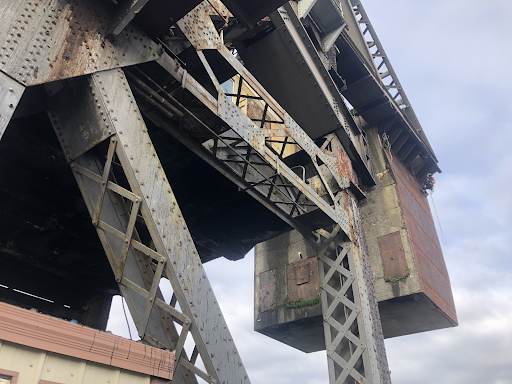
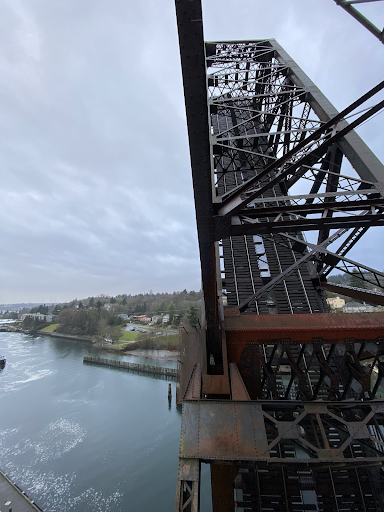
The Salmon Bay Bridge is a single-leaf bascule and steel truss bridge that carries two tracks of the BNSF Railroad between Magnolia and Ballard in Seattle, WA. Built in 1912, it has served as a vital component of Seattle’s rail and waterway infrastructure for over a century. Today, the bridge accommodates approximately 30–40 train crossings daily, including both passenger and freight traffic, and opens several times a day for marine vessels. The bridge has seen significant repairs and renovations over the years, and the structure’s health continues to be a concern due to its age and importance. In response to concerns over the performance of the lift and counterweight system, BDI was engaged by HNTB to provide a structural health monitoring system.
The system was designed to capture key performance metrics including trunnion friction, motor current, pinion shaft torque, and stresses in the counterweight system structural members. Instrumentation on this structure includes strain gages, rotation sensors, current sensors, torque sensors, and a weather station. All components were designed to integrate with BDI’s STS (structural testing system) hardware and software. The system records high-speed event data during each lift and lower cycle, as well as low-speed continuous trend data. This data is transferred from on-site storage to the cloud and processed monthly by BDI engineers, enabling the client to monitor critical performance indicators with ease.
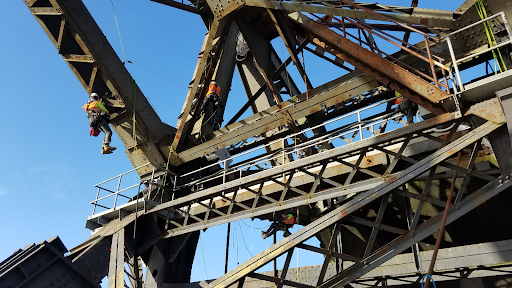
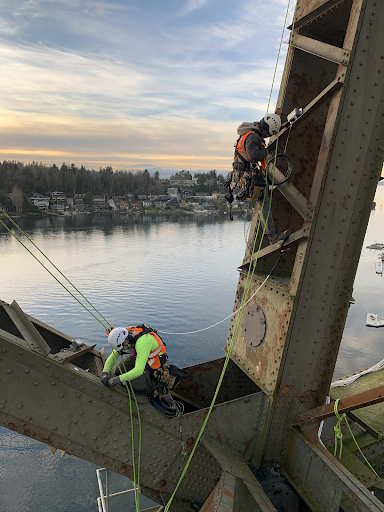
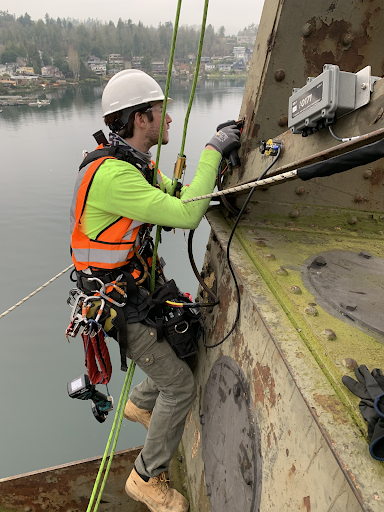
Installation was performed by BDI’s SPRAT-certified technicians and engineers, using rope access techniques to reach difficult locations without placing an aerial lift on the railway. BDI’s portable S100 StingerTM Spot Bonder [insert hyperlink] enabled efficient installation of bonded strain and torque gages while working at heights and in tight locations. Custom-built cabinetry and completion modules, combined with thorough weatherproofing, make the system resilient to environmental effects such as heavy rainfall. The system was baselined and commissioned in January 2021, with additional instrumentation being installed and integrated into the system in January 2023. It continues to operate reliably.