

USDA Forest Service
Bridges with unknown reinforcement and/or material properties present a unique challenge for owners. Lack of adequate structural information, often caused by lost or damaged plans, prevents these structures from being properly evaluated, and leads to uncertainty about the adequacy of these bridges for current design, legal, and permit loads. To help bridge owners facing this issue, BDI offers as-built verification services, using Non-Destructive Testing and Evaluation (NDT & NDE) techniques to deliver critical structural information to our clients.
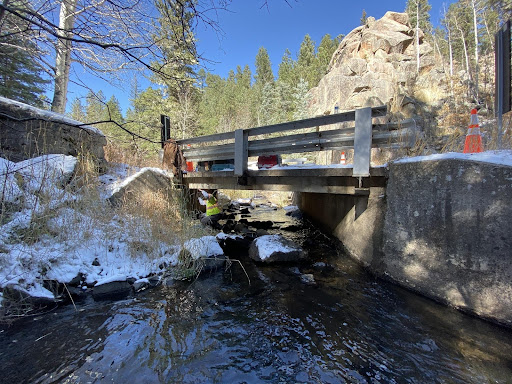
BDI had the pleasure of assisting USDA Forest Service and their consultants Great West Engineering and Benesch in advanced field investigations of nineteen bridges carrying National Forest roadways in New Mexico, Colorado, Idaho, and Montana. A variety of superstructure types were represented: reinforced concrete slab, prestress concrete slab, prestress double-tee girder, steel girder with in-span hinges, and masonry stone arch. Concrete and masonry bridges were typically evaluated to determine reinforcement configuration, depth, and spacing. Many of these were also evaluated for superstructure material properties. In addition, the pins and hanger assemblies of the steel girder bridge were investigated to evaluate any potential deterioration in these Nonredundant Steel Tension Members (NSTMs), previously denoted as fracture critical members. BDI’s NDT and NDE services supported USDA Forest Service in accurately evaluating these bridges for potential posting requirements. A summary of the methods used is as follows:
- Ground Penetrating Radar (GPR): Short pulses of electromagnetic energy are transmitted into concrete, steel, or masonry using an antenna and survey wheel assembly. These pulses are reflected to the antenna with arrival times and amplitude giving information about the location and nature of discontinuities in the material (reinforcement, air pockets, etc.). GPR was typically used on concrete bridges to identify spacing and depth of reinforcement, including both rebar and prestressing strands/ducts.
- MIRA: This ultrasonic shear-wave tomographic technique uses pulse-echo testing, like GPR, in combination with more sophisticated tomography techniques to create a volumetric 3D representation of the scanned section. MIRA was used on selected concrete bridges to identify secondary layers of reinforcement for structures with more congested reinforcement configurations.
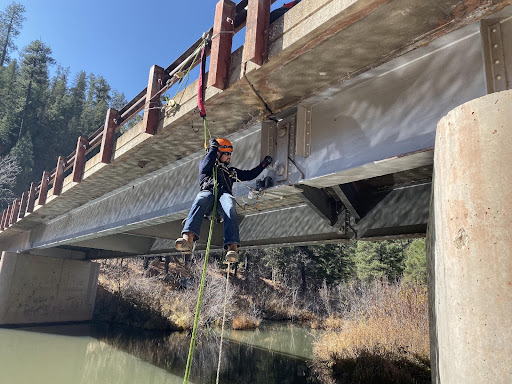
- Ultrasonic Testing (UT): One of the bridges featured steel pin and hanger assemblies, which were tested using ultrasonic waves to detect internal flaws (or “indications” to use more industry standard jargon) not visible through standard visual inspection.
- Rebound Hammer: This form of hardness testing works by impacting the surface of the concrete with a spring-loaded rebound hammer and measuring the rebound. Hardness can be used to estimate concrete strength in lieu of more destructive concrete core testing. Select concrete bridges were tested to determine approximate concrete compressive strength of the superstructure elements. Note that rebound hammering is often supplemented by a reduced set of concrete coring so that the rebound hammer results can be more accurately aligned with the break strengths determined through coring.
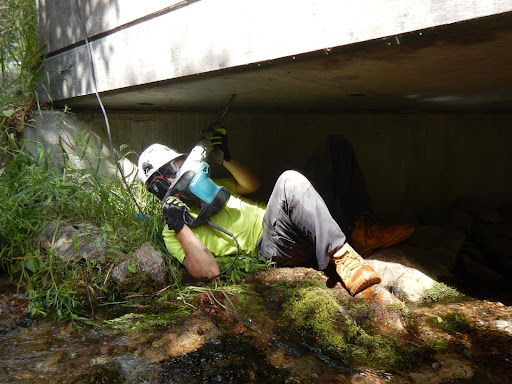
- Physical Verification of Reinforcement: After GPR/MIRA testing, physical verification at select locations was used to confirm reinforcement depth and accurately measure the size and type of the reinforcement. Physical verification is performed by selecting a desired location (usually an intersection between longitudinal/vertical reinforcement), drilling and clearing out a small hole to expose the reinforcement, taking measurements and photos, and patching the hole with approved quick-setting epoxy concrete.
This work required a diverse set of skills and certifications, including ASNT UT certification, ASNT GPR certification, specialized training for MIRA, and SPRAT rope access certification. BDI’s engineers and technicians completed all testing between 2019 and 2022 and delivered comprehensive results to Great West Engineering and Benesch, allowing for a thorough and accurate analysis of these bridges.