


What’s Hiding Behind Your Concrete? A Dam and Hydraulic Structure Owner’s Guide to Nondestructive Evaluation
Dams, spillways, sluice gates, bascule pivots, trunnions, intake structures – hydraulic structures carry some of the highest consequences of failure of any asset class an owner manages. Unlike a bridge deck you can drive across and visually monitor, much of a hydraulic structure’s condition is submerged, buried, or hidden behind massive concrete sections that were poured decades ago and were unfortunately never designed to be opened up for a look.
That’s the core challenge every dam and hydraulic structure owner faces: how do you know what’s happening inside and underneath a structure you can’t see into, without taking it offline or drilling it full of holes?
The answer is nondestructive testing & evaluation (NDT&E) and understanding what it can tell you, before you need it, is one of the most useful things an owner can do for their asset management program.
Why Hydraulic Structures Are a Different Animal
Hydraulic structures combine several conditions that make evaluation harder than a other structures, such as a typical bridge or building:
- Constant water contact accelerates corrosion of embedded steel, encourages freeze-thaw damage, and can mask surface deterioration until it’s advanced.
- Critical mechanical components – trunnions, anchor rods, pivot pins, gate hardware – carry enormous cyclic loads and are often original to a structure built 50, 70, even 100 years ago.
- Limited access. Intake structures, spillway faces, and submerged sections often require rope access, diving, or specialized rigging just to get eyes on the surface.
- High consequence of failure. A missed defect in a dam anchor system or a bascule bridge trunnion doesn’t just cost money to repair – it can mean loss of operation, environmental release, or worse.
Given all that, the question isn’t whether to evaluate these structures – it’s how to do it in a way that gives you defensible, actionable data without unnecessary cost, downtime, or risk to your team.
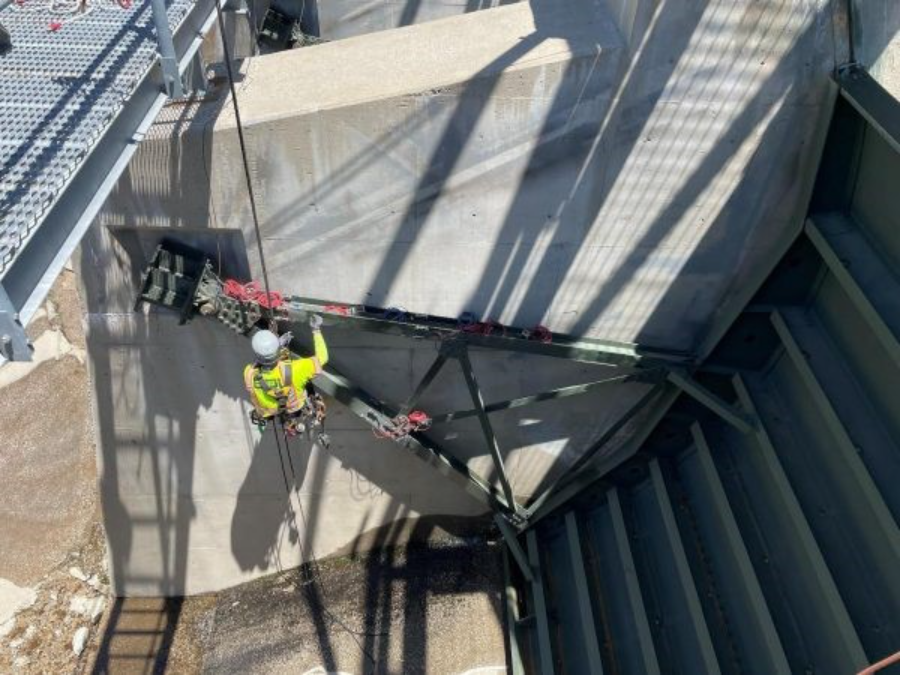
You’ve Got Questions. NDE has Answers.
Before any testing begins, a good NDE program should be built around the decisions you actually need to make. In our experience working with dam owners, DOTs, and bridge authorities, those questions usually fall into a few categories:
1. What’s actually there? Many hydraulic structure, especially older dams, have incomplete or missing as-built drawings. Ground Penetrating Radar (GPR) and ultrasonic testing can map reinforcement layout, concrete thickness, and conduit or anchor locations before you finalize a rehabilitation or modification design. This was the exact situation at Big Creek Dams 5 and 6 in California, where increasing the diameter of existing minimum-instream-flow conduits required first understanding concrete material properties and anchor conditions before design work could proceed.
2. Is it deteriorating, and how fast? Delaminations, voids, corrosion precursors, and cracked or defective welds don’t always show up on the surface. A combination of techniques – GPR, high-resolution imaging, impact-echo, half-cell potential, and ultrasonic testing – can locate and quantify subsurface defects and flag the corrosion risk of embedded reinforcement before it becomes a structural liability.
3. Are the critical mechanical components still sound? For movable hydraulic structures like bascule bridges, trunnion and anchor rod integrity is everything. Techniques like angle-beam and phased-array ultrasonic testing can assess anchor rod condition and in-situ force without disassembly – critical for structures where replacement isn’t a near-term option. That was the case on the Anna Maria Island Bridge in Florida, a 1957 double-leaf bascule bridge slated for eventual replacement but still in daily service, where hardness testing helped characterize the condition of key components keeping it operational in the meantime.
4. What’s the right level of investigation for this decision? Not every structure needs the same scope. A spillway visual condition survey ahead of a flood season is a very different investigation than a full material testing and anchor tension program ahead of a modification project. Matching the NDE scope to the decision at hand (rather than defaulting to either “quick look” or “test everything”) is what keeps programs cost-effective.
What Good Deliverables Actually Look Like
Data is only useful if you can act on it. A useful hydraulic structure evaluation should hand you:
- Visual documentation tied to specific, locatable points on the structure – not just a folder of photos
- Condition maps and statistics that let you compare severity and extent across zones, spans, or components
- Results overlaid on CAD or as-built drawings, so findings integrate with your existing engineering records rather than living in a separate report
- Engineering interpretation, not just raw data – what the findings actually mean for load capacity, remaining service life, or urgency of repair
That last point matters most. Raw scan data without engineering judgment just shifts the burden of interpretation back onto the owner. The value of a good NDE partner is turning inspection data into a decision you can defend to your board, your regulator, or your funding agency.
A Practical Starting Point
If you’re responsible for a dam, spillway, movable bridge, or other hydraulic structure and you’re not sure where your current knowledge gaps are, a good first step is simple: ask what you don’t know about the structure’s current condition that you’d want to know before the next major decision – a rehabilitation, a capacity upgrade, an operating permit renewal, or a life-extension study.
That gap is usually exactly where nondestructive evaluation earns its keep – giving you the information to plan proactively, budget accurately, and avoid the far more expensive alternative: finding out the hard way.
BDI has performed nondestructive evaluation and testing on dams, spillways, and movable hydraulic structures across the country, including anchor rod integrity testing, concrete material assessment, and structural condition surveys. If you’re planning a rehabilitation, modification, or life-extension study and need a clearer picture of current structure condition, contact BDI to discuss the right scope for your project.