

Lake Limestone Spillway
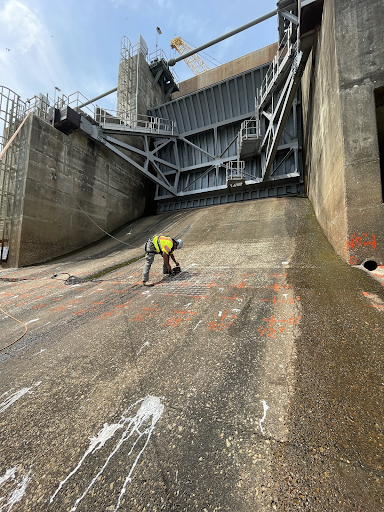
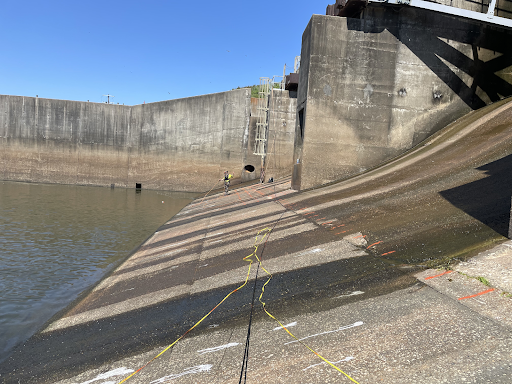
Sterling C. Robertson Dam impounds the Navasota River forming Lake Limestone, which serves primarily as a water supply reservoir. The dam, completed in 1978, features an approximately 250-foot-wide concrete service spillway which has been slated for significant rehabilitation. As part of the rehabilitation effort, BDI was engaged by Stantec to locate and measure the extent of subsurface defects over an area of the spillway.
BDI’s Nondestructive Testing and Evaluation (NDT-E) investigation included:
- Visual Inspection: Visual inspection was conducted to identify cracking and section loss at the surface of the concrete.
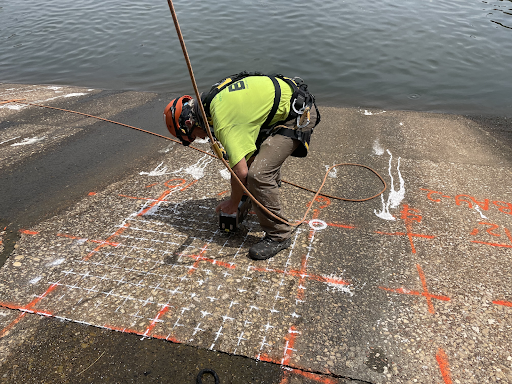
- Impact Echo (IE): This method works by striking concrete to generate waves which reflect off internal boundaries where there is a change in acoustic impedance. The reflected signals converted to frequency spectrum data using a Fast Fourier Transform (FFT). If the concrete is intact and free of defects, the frequency spectrum will show a clear peak corresponding to the concrete’s thickness. If there are delaminations or voids, the spectrum will show different patterns, indicating the presence and depth of anomalies. IE Testing was performed per ASTM C1383.
- MIRA Ultrasonic Tomography: This method uses an array of transducers to send and receive low-frequency shear waves. The amplitude and arrival times of these waves give information about the location and nature of discontinuities in the material (reinforcement, air pockets, etc.). By using an array of transducers along with sophisticated tomography techniques, MIRA can present a volumetric 3D representation of the scanned section.
BDI’s trained technicians and engineers performed inspection and testing in May 2025. A system of ropes, harnesses, and PFDs was used to ensure safety while working on this spillway. MIRA and IE Data was processed by BDI’s engineers to identify the presence and depth of anomalies. Both forms of testing identified significant anomalies below the reinforcement layer, with 2 of the 5 spillway bays, likely those which have seen more use, having significantly increased anomalies.